Detroit Free Press
Child should have right to know genetic information
Detroit Free Press, U.S.A., BY MURRAY DAVIS March 6, 2007
It is frustrating when our laws or proceedings in the judicial system eschew common sense, medical science and society. An important case in point is Minor J, the Michigan youth seeking the identity of his birth father in order to know his genetic medical history and any predispositions to diseases.
Such expectations are already standard practice for
sperm or egg donors, and Michigan's full disclosure
adoption law requires that the medical histories of
birth parents accompany the adopted child on to his or
her new life.
However, through a technicality, Minor J's rights have
fallen through some courtroom cracks.
Diane J and Mr. J were married in 1982. They divorced in 1995. Minor J was born in 1989. The divorce agreement called for joint custody, with Mr. J paying child support. In 2004, Mr. J began to doubt that the now 17-year-old boy was his biological child, a suspicion confirmed by two separate DNA tests. Minor J asked his mother for the identity of his father. She gave another name, but three months later another DNA test determined that this man, Mr. X, was also not the biological father.
Diane J refuses to provide any other names and, despite these DNA results, still ridiculously asserts that Mr. J is the biological father.
Minor J, represented pro bono by nationally known family law attorney Henry Baskin of Birmingham, has filed suit against his mother. The case is now before the Michigan Court of Appeals after a Macomb County circuit judge ruled that Minor J had no legal standing to bring the suit. Under antiquated Michigan law, Minor J is a legitimate child, as Mr. J and Diane J were married at the time of his conception and birth. And, it was ruled, a legitimate child cannot ask the courts to name another man as his father.
Although this case has revealed marital paternity fraud, it is not a paternity establishment case in the traditional sense. No inheritance is at stake. Child support payments are no longer an issue. But something more valuable is: information, which could help Minor J or his offspring practice preventive medicine and avoid future disease.
This case is being watched around the country. Baskin -- who is only asking for the genetic information, not even a name -- has the American Medical Association and the National Institutes of Health on his side. With good reason. In addition to the Michigan adoption law and conception donor practices already cited, the entire thrust of the modern health care era has been to establish and cultivate the informed patient. Most major hospitals and HMOs include access to and accuracy of medical information as part of their Code of Conduct or Patient Rights and Responsibilities policy.
Unfortunately, many of our laws are based on English common law, drafted well before the advent of modern-day medicine, which relies on accurate medical histories and, increasingly, genetic histories and sophisticated diagnostic technologies.
Does a child have equal protection under the law -- a right to know the medical history of both biological parents to help ensure a healthy lifestyle? It should go without saying.
Fortunately, Baskin has promised that he will not give up on Minor J's case.
When Baskin succeeds, our children and society will both be healthier for it.
MURRAY DAVIS of Southfield is president of the board of the National Family Justice Association, nfja.org, a nonprofit education and advocacy organization for issues that adversely affect American children and families.

Book rebuts divorced dad myths
The Detroit News, Detroit, MI., U,S.A., Wednesday, October 21, 1998, Editorial and Opinions By Cathy Young
In a society sensitive to stereotypes, few groups have as bad an image as the divorced father. Despite a few positive portrayals in movies like Mrs. Doubtfire, he is generally seen as a cad who walks out on his wife and kids to vacation in Hawaii with a blonde half his age.
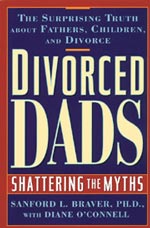
Divorced Dads: Shattering the Myths (Penguin Putnam), written by Arizona State University psychologist Sanford Braver with Diane O'Connell, is a powerful and well-documented brief in defense of this despised creature.
Braver, who has conducted an eight-year study of parents after divorce, knocks down the stereotypes one by one. To begin with, most divorced fathers don't "walk out." At least two-thirds of the time, the mother is not only the one who files for divorce but the one who wants out of the marriage. And it's usually not, as many assume, because the father beats her, drinks or cheats; most commonly, mothers cite such reasons as "growing apart" or "not feeling loved or appreciated."
Nor is it true that, once divorced, fathers are likely to desert their children emotionally and financially. Most fathers who are steadily employed consistently pay child support (their record is especially impressive if one looks not only at mothers' reports, on which most statistics are based, but at fathers' own reports) and work to stay in their children's lives. So-called "runaway dads" are often "driven-away dads": they vanish because their ex-wives keep them away.
Finally, there's the mother of all divorce myths: that men benefit economically from divorce, while women and children are impoverished. The famous factoid from Lenore Weitzman's 1985 book The Divorce Revolution - women's standard of living drops 73 percent in the year after divorce, that of men goes up 42 percent - was exposed as erroneous two years ago. But her critics' alternative calculations still showed a drop for women and a rise for men.
All those researchers, Braver shows, made one big mistake: they didn't factor in the tax code, which favors the single custodial parent. They also omitted such things as the father's spending on children during visitation. After these adjustments, the economic effects of divorce are similar for both sexes; mothers may even have a slight advantage. Weitzman and other feminist scholars have claimed that divorce settlements are tilted in favor of fathers because men are favored by a male-dominated system and are Read More ..gressive negotiators. Yet on average, mothers are Read More ..tisfied with divorce settlements than fathers. Ten percent of mothers in Braver's sample thought the system was slanted in favor of fathers, while 75 percent of fathers thought it was slanted in favor of mothers - and more than a quarter of mothers agreed!
Braver doesn't paint all divorced fathers as martyrs; he certainly doesn't paint all divorced moms as vindictive shrews. He admits that irresponsible or abusive 'bad dads' exist, and that sometimes the mother tries in vain to keep the father involved. But Divorced Dads argues that these are the exceptions.
Our public policy has focused on hunting "deadbeat dads" while disregarding the bigger problem of disenfranchised dads. What are the solutions? Encouraging mediation instead of litigation. Programs to help divorced fathers remain active parents. A presumption of joint legal custody and substantial contact with both parents, rebuttable by evidence that this is not in the child's best interest. (It's worth noting that a shared parental responsibility bill has been stuck in the House Judiciary Committee of the Michigan state legislature for a year and a half.)
Braver's work is unlikely to receive the same acclaim as Weitzman's now-discredited research, because it challenges our cultural prejudices rather than reinforce them. Both liberals and conservatives have promoted the image of men as the bad guys in divorce - the former because it squares with their view of women as victims of male oppression, the latter because it squares with their view that men are biologically predisposed to sow their wild oats. From now on, any politician or commentator who traffics in these stereotypes should be required to read Divorced Dads.
*Cathy Young is vice-president of the Women's Freedom Network. Her column is published on Tuesday. You may write her at The Detroit News, Editorial Page, 615 W. Lafayette Blvd., Detroit, Mich. 48226. Her e-mail address is 71774.1305@compuserve.com
Copyright 1998, The Detroit News