

Study aims to salvage image of fatherhood
First of its kind in Canada: 'Fathers are often treated as buffoons in our public images'
National Post, by Heather Sokoloff, Thursday, December 4, 2003
University researchers hope to debunk the pop-culture image of fathers as incompetent bumblers with the first major national study of male parenting.

...Al Bundy, and incompetent fathers such as...
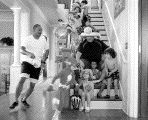
... Eddie Murphy in this year's movie Daddy Day Care.
The $1.6-million study will look at everything from why so few fathers take paternity leave to the differences between straight and gay fathers in a five-year project involving eight universities, 25 community organizations and the federal government's Social Sciences and Humanities Research Council.
"Our goal is to bring fatherhood out of the shadows," said Kerry Daly, a professor at University of Guelph's department of family research and co-chairman of the newly created Father Involvement Research Alliance.
"Fathers are often treated as buffoons in our public images. TV and advertising play on this idea that fathers are deficient and inadequate at what they do.
"That is not reflective of the sincere effort many men are making trying to be more involved with their children."
Dr. Daly said fathers often want to take on greater parenting responsibilities, but hold back because cultural norms say their primary role is as a financial provider, while mothers may feel uncomfortable giving up control of the scheduling of children's activities.
"Why don't men do more at home?" Dr. Daly asked. "We need to reframe the question and ask, 'What is it about the family dynamic that keeps us stuck in this pattern?' "
According to Statistics Canada, fathers spend two-thirds of the time mothers do on child care. Only 10% of new fathers have taken paternity leave since the federal government expanded the program in 2000.
Negative stereotypes about fathers come from TV shows that depict male parents as overgrown children, such as Homer Simpson and Married With Children's Al Bundy, or movies such as Mr. Mom and Daddy Day Care that poke fun at the idea a man could be a child's primary caregiver.
"Homer is certainly the champion incompetent father," said Dr. Daly, the father of two teenagers.
Societal expectations for fathers are so low, he noted, that the news media often portray involved fathers as heroes -- suggesting good fathers are the exception, not the norm.
Research shows children of involved fathers do better in school, exhibit higher levels of emotional well-being and have an easier time making friends, even if the father does not live with the children.
And men who participate in family life report less stress and Rmore satisfaction, Dr. Daly said.
He said Canada lags behind the United States and Australia in developing resources for fathers. Bill Clinton, the former U.S. president, secured funding for the National Center for Fathering, for example, while the University of Pennsylvania maintains the National Center on Fathers and Families.
The Canadian project, part of the federal government's Community University Research Alliance, will focus on issues raised in seven different research groups: aboriginal fathers, new fathers, fathers of children with special needs, divorced fathers, teenage fathers, gay fathers and immigrant fathers.
Dr. Daly hopes the research will help people understand fatherhood is something completely different from motherhood and accept that each gender brings a different approach to parenting.
For example, Andrea Doucet, a researcher from Carleton University, found stay-at-home fathers sometimes encounter resistance from mothers when they attempt to join neighbourhood playgroups. Even when they are welcomed, the fathers had little to contribute to discussions about breast-feeding or recuperation from childbirth. Instead, the fathers preferred doing outdoor activities with their children.
Dr. Doucet also found stay-at-home fathers took a masculine approach to the home, preferring bathroom renovations to doing the laundry.
"I think we've been on this track, that we thought mothers and fathers would eventually be fully interchangeable," Dr. Daly said. "But part of the recognition we are coming to is that will never be the case.
"There was an expectation that men would eventually turn into good mothers. That is not going to happen. Men can be very caring, but in a different way."
Copyright 2003 National Post
RESEARCHING 7 TYPES OF DADS:
Divorced and separated: Judges usually decide custody cases assuming a father's responsibilities to his children are largely financial and often award sole custody to the mother, says Edward Kruk, a University of British Columbia professor. His group will examine the nature and extent of separated and divorced fathers' responsibilities to their children.
Teenage: Annie Devault, a Universit du Qubec en Outaouais professor, says a big problem for young fathers is overcoming societal preconceptions that they do not want to be involved in their children's lives. Dr. Devault is putting together a group of teenage fathers in Ottawa and helping them make a film about their experiences, which will be used by social service organizations across the country as an education resource.
First time: Ed Bader, who runs the program Focus on Fathers for Catholic Community Services of York Region is preparing workshops for new fathers on how to help their children develop and how to manage their own stress.
Aboriginal: Jessica Ball, a researcher from the University of Victoria, will lead a project investigating how to get fathers more involved in two local early childhood education programs. Her group will write recommendations on how the programs can more fully include fathers.
Children with special needs: Ted McNeil, a social worker at Toronto's Hospital for Sick Children, will oversee a research group that will come up with recommendations on how medical and social service organizations can include fathers in the parenting of special needs children. Often, these services are used primarily by the children's mothers.
Gay: Rachel Epstein, co-ordinator of the Lesbian Gay Bisexual Parenting Network for the Family Services Association of Toronto, will look at some of the differences and similarities between how gay and straight fathers parent their children. Much research has already been done on lesbian parenting, showing that children do not appear to suffer negative effects when they are raised by two women. Ms. Epstein will look at how male homosexual couples divide parenting and housework responsibilities.
Immigrants: David Este, of the University of Calgary, will examine why children and their mothers who have immigrated from foreign countries seem to have an easier time adapting than fathers. The situation sets up the potential for conflict when the father is having difficulty letting go of cultural behaviours that are not appropriate in Canada. This group will work with immigrant men to help them shift their thinking.