
One of Canada's two national newspapers
Odd man out
National Post, December 1, 1998, By Donna Laframboise
"In order to stay in my kid's life, I tiptoe, I bend, I swallow my pride. [My former wife] is the gatekeeper, and she can be very arbitrary. I say or do whatever's necessary to keep her from getting mad and cutting me off from my kid."
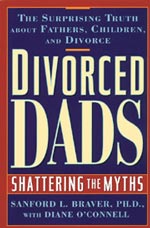
These are the words of a divorced father in a new book by psychologist Sanford Braver titled Divorced Dads: Shattering the Myths.
Prior to experiencing divorce firsthand, the father says, he had always been critical of men who failed to live up to their post-divorce obligations. He says he always assumed that decent men who make career sacrifices in order to spend time with their children, who are not substance abusers, and who don't beat their wives would be given credit during a marital breakdown.
"But my wife had an affair with some guy from her office," he says. "She left me for him and the two of them now live with my kid, and there was nothing I could do to stop it. My lawyer laughed when I said, 'But she's the one who did wrong!' "
This father says he has a message for "all the smug dads out there: This could happen to you. You have no rights -- none that will be enforced, anyway. Your kid who you love so much can be ripped away from you."
There is no shortage of such heart-rending anecdotes between the covers of Divorced Dads, but the book is much more than this. Indeed, it is the result of an eight-year, federally funded, $10-million study of 1,000 American couples that concludes that virtually everything society believes about divorced fathers is dead wrong.
At first, Braver and his research colleagues didn't question the idea that most fathers renege on child support payments, that divorce is overwhelmingly initiated by men trading in their middle-age spouses for younger women, that males enjoy care-free adolescent existences after their marriages end, or that divorce settlements invariably favour men. Instead, the researchers started out trying to determine what factors might encourage divorced fathers to behave more responsibly.
Then reality hit. "I found that the studies from which all of our thinking about divorced fathers came were questionable because there were gaping holes in the information," writes Braver. "In fact, almost none of the studies had ever bothered asking fathers about anything at all."
Big surprise that the image of fathers that emerged when previous researchers interviewed only men's former wives was less than complimentary. But what alarms Braver is that this "inaccurate and damaging stereotype" has been adopted by legislators and judges, and is therefore colouring divorce settlements and damaging millions of lives.
Braver argues that, deeply troubled by the steep rise in divorce rates over the past quarter century, society has looked for a scapegoat, "a villain in the drama. Clearly it cannot be the children's fault," he says. Nor "is it fashionable or acceptable to blame mothers or the women's movement. But there is one group remaining in America that it is not socially unacceptable to derogate: Males."
The U.S. Census Bureau has, for years, compiled its numbers regarding the amount of child support men actually pay based solely on information provided by mothers. (No reliable, independent data on what men pay exists.) Worse, it has skewed the numbers even further by mixing together never-married fathers with divorced ones -- two starkly different populations in terms of the commitment they demonstrate toward their offspring.
Braver's research found that "the single most important factor relating to [child support] nonpayment is losing one's job." The men in his study who remained fully employed claimed they paid every penny of the child support they owed. Their former wives sometimes disagreed with them, but even they admitted that they received between 70 and 80% of the money -- a far cry from the scandalous notion that most child support remains unpaid.
While Hollywood movies such as The First Wives' Club resonate with affluent middle-age women afraid of being dumped by their high-achieving husbands in favour of 20-year-olds, the reality is that two out of three divorces are initiated by women. When Braver asked the couples in his study whose idea it had been to seek a divorce, the answer remained constant: Women most often wanted out and were less likely than men to regret the divorce afterward.
In Braver's words: "There is not a single study which doesn't find the same proportions. . . . I call the fact that women overwhelmingly initiate modern divorces the 'dirty little secret' of divorce research."
Nor is it true that statistically large numbers of women flee their marriages because they find themselves co-habiting with violent brutes. When asked how important 27 possible factors had been in the breakdown of their marriage, "violence or abuse were strikingly absent," says Braver. Instead, "less dramatic factors predominated, such as 'gradual growing apart,' 'differences in lifestyle or values,' 'not feeling loved or appreciated by spouse,' and 'spouse not able or willing to meet my needs.' "
While popular culture leads us to believe that, freed from their day-to-day familial responsibilities, divorced fathers typically behave like 'Casanovas and tomcats,' not a shred of social science research supports this view. In fact, says Braver, while divorce is considered one of the most stressful events of modern life and all parties suffer emotional anguish, mothers tend to recover more quickly than do fathers. "This is not a fleeting difference that evens out over a period of months," says Braver, "Rather, these gender imbalances in coping can last as long as 10 years."
Mothers are far more likely to keep both the kids and the house, while fathers are frequently forced to start over from scratch. "Imagine that your house burned down and you had no insurance," says Braver, who points out that is, in fact, the situation in which many divorced fathers find themselves. While mothers draw a sense of security and well-being from "familiar surroundings and the continued presence of their children," fathers suffer from a lack of identity and a loss of structure in their lives.
"Society wants to imbue divorced fathers with a fictitious image of well-being that is a gross distortion," says Braver. "Yet it is women who get society's sympathy, who are viewed as valiant innocent victims, suffering at the hands of the irresponsible male."
Even more significant is the fact that, despite all the feminist rhetoric to the contrary, it is men -- not women -- who get beaten up in divorce court. "Not a single father thought that the system favoured them in the slightest," reports Braver, and "three times as many mothers thought it favoured mothers as thought it favoured fathers."
'Nearly all parents want to do what's right for their kids.'
When the couples were asked how satisfied they were with a variety of factors -- such as child custody and the amount of child support -- women reported being far happier than men. "What we found is astonishing, and completely counter to the claims that women either are or feel misused," says Braver. "Women feel more satisfied with their divorce for two reasons: because they are more likely to get the deal they want than men are, and because they feel they have greater influence over the settlement process."
Braver is careful to acknowledge that some divorced fathers are, indeed, cads who embody all the negative stereotypes. He also admits that a small percentage of both male and female parents are psychotic or abusive toward each other or their children.
But he argues that our most reliable empirical data indicates that the vast majority of divorced fathers are not villains. Those who do disconnect from their children's lives, he says, have often been pushed away by former wives -- many of whom openly admit to discouraging contact between their children and their former spouses.
While most women initially oppose sharing legal custody of the kids, Braver says the benefits of this arrangement are so unmistakable from the children's perspective "that most major researchers have now joined the call to support it." Children in such situations "were significantly better adjusted in that they exhibited less behaviour problems, impulsive behaviours, depression, and antisocial tendencies than children in sole custody families," he writes.
More over, Braver found that joint custody arrangements did not result in increased conflict between divorced parents. A number of divorced women he interviewed admitted that their own burdens have been lessened by the active participation of their former husbands in their children's lives.
"Nearly all parents want to do what's right for their kids," says Braver, arguing that professionals must therefore help to educate them. "Without question, what helps children of divorce is two involved, co-operative, and well-functioning parents" who value and respect the crucial role each of them plays in their children's lives.
Copyright Southam Inc. All right reserved.