
The Truth About Deadbeat Dads
Reader's Digest Canada, April, 2001, BY GLADYS POLLACK
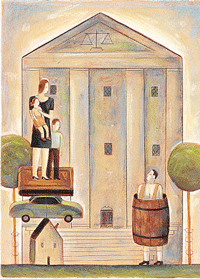
For decades, they have been pictured as living the high life -- driving their Porsches, vacationing in exotic places -- while their former wives and their children haunt food banks and live off welfare. Branded as "deadbeat dads," they are viewed as heartless men who have simply walked away from their family responsibilities. The fact is, sure, there are some dads who fall into this category -- men who have fathered children but don' t want to honour their obligations to them -- but a closer examination reveals another story.
In general, statistics indicate that between 85 to 91 percent of Canadian children covered either by private or court-ordered child-support agreements actually receive payments, the vast majority receiving regular support payments. And statistics also reveal the close association between the regularity of payment and the frequency of contact between fathers and their children.
Studies also show that many noncustodial fathers who do not pay child support simply can' t afford to. Some are unemployed or on sick leave. In fact, one of the best predictors of nonpayment is the unemployment rate. Higher incomes are associated with higher compliance rates, and lower incomes with lower rates. One study suggests that a father' s ability to pay, in addition to his willingness to pay, determines the extent to which he fulfills his child-support obligations.
Burdened by unrealistic court- imposed support payments, continuing legal fees, increased taxes due to changes imposed by Bill C-41 and estrangement from their children, some men find themselves caught in a downward spiral of depression and have resorted to the ultimate escape: suicide. With a divorce, funds that were unable to support one household are now expected to support two. Add to this the cost of expensive litigation, the fact that one party may be trying to use money as a means of obtaining concessions such as access or custody, and we have a recipe for disaster -- with children often caught in the maelstrom
What happens after the break-up of the family? Eighty-seven percent of children end up living solely with their mothers after a parental separation (only 7 percent live with their fathers). Only 30 percent of children report visiting their fathers every week. One quarter of children visit their fathers irregularly -- once a month or on holidays. A whopping 15 percent never see their fathers.
And what has Bill C-41 done for fathers? Under the changes to the tax treatment of child support, which came into effect on May 1, 1997, it is no longer taxable in the hands of the receiving parent and no longer deductible in the hands of the paying parent. It is worthy of note that when the Parliamentary Secretary to the Minister of Justice and Attorney General of Canada rose in Parliament to speak in favour of Bill C-41, he stated that the revenue derived from ending the deduction of child-support payments would yield the federal government more than an additional $1 billion dollars over a five-year period.
Finding solutions that are in the best interests of the children was the aim of the 1998 Senate-Commons Joint Committee on Child Custody and Access. Understanding that children of divorce are entitled to a close and continuing relationship with both parents, the committee recommended that the terms "custody" and "access" be stricken from the Divorce Act and a new term, "shared parenting," be incorporated. Both parents would have access to information and records regarding the child' s development and social activities, such as school and medical records and other relevant information. The federal government has apparently shelved the committee's recommendations, however, in the interests of further study.
Yes, there are some deadbeats who don't care about their kids. But it's unfair and unproductive to label every father who falls behind in his support payments a "deadbeat."