
A study in First Nations 101
With as many as 10,000 native kids in Toronto, the public board is boosting heritage awareness
The push brings fresh insight into a group seen as the `invisible' visible minority, Louise Brown writes
The Toronto Star, by LOUISE BROWN, EDUCATION REPORTER, June 20, 2006 page A3
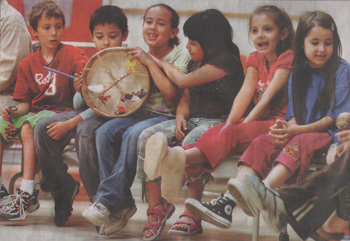
Natalie G****** and her Grade 2 classmates at Humewood Community School try out a drum, part of a series of activities at the school to mark National Aboriginal Day
The Grade 2 children at Humewood Community School are thrilled to be smoking in class.
Not puffing on cigarettes, but breathing wafts of burning sage in an aboriginal ceremony the school is holding to help students better understand their native classmates.
As Humewood mother Joanne Vautour, who is part Ojibwa and part French, circles the room with the small dish of sage for this traditional "smudge" ceremony designed to clear away negative thoughts, child after child reaches into the smoke and waves it over their face and body.
"I'm native, so I've done this before and I know some Ojibwa words too," says a beaming 7-year-old Keesha Newman as she waits for the drumming workshop to begin.
At this west Toronto grade school, which has 20 students of native background, children, teachers and even parents have been taking a crash course in First Nations culture over the past week in honour of National Aboriginal Day tomorrow. Children have learned how to play lacrosse, which was invented by native North Americans, and taken turns baking traditional bannock bread. They heard the native legend about why strawberries are shaped like hearts, and learned of the harsh realities of the prairie buffalo hunt.
It's all part of a new push by Canada's largest school board to bring fresh insight into a group often seen as the "invisible" visible minority.
"We have 8,000 to 10,000 aboriginal children in Toronto more than any other city in the province but they tend to go underground; they're a group that don't often speak out because they have been discriminated against for so long," says Ojibwa educator Cathy Pawis, the Toronto District School Board's new central principal in charge of native education.
"Now, for the first time, the board is making them a priority."
With a more native-sensitive social studies curriculum, a new advisory committee on native affairs and Rmore training for staff and students about aboriginal culture, the board is taking steps to help boost awareness of native heritage.
This spring, 50 principals visited the Native Canadian Centre for a crash course in elements of aboriginal culture, from the impact of residential schools to the protocol for showing respect to elders. The board co-hosted a recent teachers' conference at York University on how to make elementary schools more sensitive to native culture. Each school has been sent tips on how to observe National Aboriginal Day tomorrow, and the board will hold a public celebration at its offices in Etobicoke.
And native learning is a growing priority at schools across the province:
The Ontario government has drafted a sweeping plan to help the province's 50,000 aboriginal students catch up to their non-native peers by the year 2016 in areas where they lag behind, from test scores to high school graduation and enrolment in higher learning. The ministry is gathering feedback across the province on the proposed policy that would promote the training of more aboriginal teachers, Rmore literacy help for native students, more tracking of native children's learning and more outreach to native parents.
"With such a huge gap in achievement between native and non-native students, we know we need to target very focused support and we know it will pay off," Education Minister Sandra Pupatello said yesterday. The government plans to fine-tune its new policy this fall, after consultations.
The Ontario Public School Boards Association has made aboriginal education a priority and will add a First Nations trustee to its board of directors to suggest ways schools can help native children succeed. Already seven school boards across Ontario, including the Toronto District School Board, have decided to track race-based statistics this fall on native student achievement.
With funding from several universities, teachers' unions and charitable foundations, Lieutenant-Governor James Bartleman will launch 35 summer literacy camps this summer in 28 remote fly-in reserves across northern Ontario, to promote the love of reading among children who often have little access to books. All 2,000 campers will receive a free book every two months next year from donors across Ontario.
In Toronto, school awareness programs like Humewood's are seen as timely.
"When we see situations like Caledonia (where natives have been engaged in a bitter land dispute), we know it's important to talk to children about the issues that can lead to them," said school trustee Mari Rutka, who has taken on special responsibility for native education at the board.
Humewood principal Rita Garry said the idea of a week-long native festival arose last fall after some native families said they felt disconnected from the school, citing occasional stereotyping in the classroom and isolated name-calling in the playground.
Garry called a meeting of staff and parents, who formed an "aboriginal community circle" that organized the week-long Aboriginal Day festivities.
To Keesha, the native student, it has been a chance to strut her stuff.
"I know that meegwetch means thank you in Ojibwa, and weesnik means let's eat!" said Keesha.
Classmate Serena Sessa was suitably impressed. "Keesha's native," said Serena, "so she really knows a lot."
