
Put kids first, judge tells parents
His family court sees conflicts daily
Complex reasons why dads absent
The Toronto Star, ANDREA GORDON, FAMILY ISSUES REPORTER, Jan. 16, 2006.
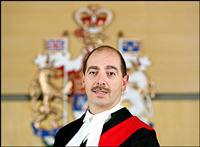
Children pay a big price when they grow up without fathers, but it's unfair to blame it all on men who walk away, says a North York family court judge.
Harvey Brownstone says he welcomes recent public discussion about the risks faced by kids who don't have a father in their lives.
But Brownstone, who has seen thousands of support, custody and access cases during his 11 years on the bench, says there are many misperceptions about why it's happening. And most often it's because parents can't get along or want nothing to do with each other.
"You would be shocked how many men say, `I didn't know I had a child until I got these court papers,'" he says in an interview at his office in the provincial court building.
And, when they find out, almost all of them take steps to become involved in their child's life, even if it's years after the child was born, Brownstone says.
"Fathers should not be portrayed as generally not caring, because they're not," he says. "When you're talking about deadbeats, I think it's important to know that many, many guys are completely cut out, because they were never told they were the father and then, when they find out that they are the father, they want to start a relationship with the child."
Brownstone says, in the majority of such cases, the parents were involved in a casual relationship, which may have ended badly, with the mother not wanting to have anything to do with the child's father, even though her child is legally entitled to financial support.
Sometimes men who know they are fathers but don't have money to pay support assume they have no right to request access to their child. But the two are separate legal issues.
more than 40 per cent of the cases he sees involving matters of support, custody and access are driven by child welfare staff, who insist mothers file for child support from known fathers if they want to continue receiving social assistance.
In most cases, fathers who are called to court will then ask for access to their children. But because they are strangers, building the relationship has to happen gradually, perhaps starting with visits in the presence of the mother or at supervised access centres. It's a process that can take many months. It's also one that some fathers give up on, even if they're paying support, in cases where there's too much nastiness and fighting taking place at every adult encounter.
"In order to create a relationship between a total stranger father and a child, it takes time and it takes good faith on the part of both parents," Brownstone says. "Unfortunately, the couples we see have great difficulty demonstrating a child-focused approach to fatherhood."
Brownstone, 49, is a former director of what is now known as the Family Responsibility Act (formerly called the Family Support Plan), which is responsible for enforcing child support. He believes passionately that a child has the right to have a relationship with both parents as long as the court feels it is in their best interests and that parents have obligations to do everything they can to allow that.
He says when mothers name someone as the father of their child, DNA tests show they are almost always right. But those tests cost $650 and not all fathers are willing to pay for it until the court orders it. Often, the court will tell them the mother will cover the costs if it shows they are not the biological father.
In the wake of recent gun violence in Toronto, a Star story Jan. 7 raised the issue of how kids are affected when they grow up without their fathers.
Toronto pastor Bruce Smith said the gangs and guns that have grabbed headlines lately reflect his experience growing up without a father in Texas, a situation he says often breeds feelings of powerlessness and frustration among boys.
"As a young kid, you need that security, so if you don't have it, you will try to create it, by being tough, by being mean, being part of a gang," he said. And it is a problem regardless of race or income.
Brownstone also says paternal involvement is not just an issue limited to lower-income communities or certain racial groups.
"There is a perception that this is a poverty issue," he says. "Rich kids are just as likely to get into trouble as poor kids if they are not properly parented."
To him, that means parents spending time with kids, knowing where they are and what they are doing, and parents who function as a team and don't put their children in the middle of their conflicts.
Brownstone, who divided his time between family court and young offenders court for his first six years on the bench, says he saw teens from a cross-section of backgrounds, including wealthy homes.
"The high incidence of violent behaviour from boys was strongly correlated to being fatherless but it was not, in my experience, prevalent among any one community. It was not related to one race or community, but it was related to having no father."
The issue is not about the child's socioeconomic background, he says, but about parents who cannot resolve their disputes and kids who fall through the cracks.
"I've seen many custody cases here with wealthy people. Those parents were busy professionals. There's a nanny raising those children and if I were going to be honest about who should get custody, it would be the nanny. That's the person these children are most bonded to."
Kids may act out in different ways. "It may manifest itself in getting in with the wrong crowd and getting involved with guns," he says. "I have dealt with rich kids who got involved with drugs. I have deal with rich kids who have gotten pregnant and had tremendous sexual promiscuity. It's not about rich or poor."
He says there are several things that could be done to prevent duelling parents from doing harm to their children. Parents should do everything they can to avoid having to sort it out in court. "Litigation is not a good way to make decisions."
He also supports the idea of mandatory parent education for anyone dealing with questions of support, custody and access.
Brownstone would like to see anyone involved with children, including schools, physicians' offices and social services agencies, sending the message that involvement of both parents is important to a child's emotional well-being and healthy development.
"I say this in court: `You have to love your child more than you dislike each other and if you can do that and always make it all about the child and put aside your own personal animosity, then your child should grow up healthy.'"