
National Longitudinal Survey of Children and Youth: Home environment, income and child behaviour
1994/95 to 2002/03
Analysis of long-term data from the National Longitudinal Survey of Children and Youth found that changes in punitive parenting practices in the home were linked with changes in child behaviour eight years later.
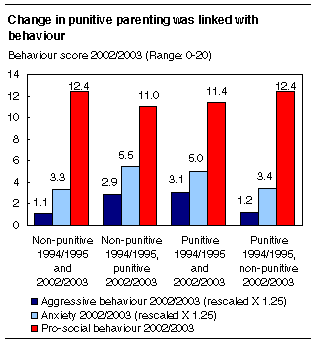
Children showed higher levels of aggressive behaviour when their parents were Read More ..nitive. They also showed higher levels of anxiety and lower levels of pro-social behaviour, the latter defined as actions that benefit another person with no reward for oneself.
Note to readers
The National Longitudinal Survey of Children and Youth (NLSCY) is a long-term study by Social Development Canada and Statistics Canada, which follows the development of children from birth to early adulthood. The survey began in 1994/95 with a sample of children under the age of 12. The survey is designed to collect information about factors influencing the social, emotional and behavioural development of children, and to monitor the impact of these factors on their development over time.
This report releases preliminary findings from Cycle 5, collected eight years later, in 2002/03, when the children were aged from 8 to 19. Specifically, it reports on 4,129 children aged 2 to 5 during the first data collection period in 1994/95, who were 10 to 13 during the fifth collection phase in 2002/03. Information was gathered from the parents when the children were aged 2 to 5 and from both parents and the children when they were 10 to 13. This sample represents about 1.5 million children aged 2 to 5 living in Canada in 1994/95
An analysis of partial non-response, including response rates for key variables, is available on request.
Definitions
Income status: Measured as the ratio of household income to the relevant low-income cut-off level (LICO) for each family. Low-income families are those who devote a larger share of income to the necessities of food, shelter and clothing than the average equivalent family. Households were divided into a low-income group, in which the household fell below the LICO, and a higher-income group, in which the household income fell at or above the LICO.
Child aggressive behaviour: To measure aggressive behaviour in children, the NLSCY asked how often a child behaved or reacted in aggressive ways, such as whether they got into many fights, or how often they bullied or were mean to others.
Punitive parenting style: Punitive parenting for children aged 2 to 5 was measured by asking parents how often they used physical punishment, or yelled at the child and, on the other hand, how often they calmly discussed the problem or described more acceptable behaviour to the child. Children aged 10 to 13 were asked how often parents yelled at them, hit them or threatened to do so.
The link between punitive parenting practices and child behaviour was found when children were aged 2 to 5 in 1994/95 and eight years later in 2002/03, when they were aged 10 to 13.
Change in punitive parenting linked to change in aggressive behaviour
Children whose parents' practices changed from punitive to non-punitive eight years later scored just as low in aggressive behaviour as youngsters whose parenting environment was not punitive at either of those ages. This occurred regardless of the children's level of aggressive behaviour when they were younger.
Similarly, children whose parenting environment changed from non-punitive to punitive had aggressive behaviour scores that were just as high as those whose parenting environment was punitive at both ages.
These findings are consistent with an earlier NLSCY study released in October 2004. It found that changes in punitive parenting practices in the home between the time that children were aged two to three and eight to nine were linked with changes in aggressive behaviour. The present analysis found the same result two years later for these children, and extended the findings to an older group of children.
Change in punitive parenting linked to change in child anxiety, pro-social behaviour
In addition to a child's aggressive behaviour, changes in punitive parenting practices were linked with changes in child anxiety and pro-social behaviour.
Children whose parenting environment changed from punitive to non-punitive between the time they were aged 2 to 5 and 10 to 13 scored just as low in anxiety at the older ages as those whose parenting environment was not punitive at either time.
On the other hand, children whose parenting environment changed from non-punitive to punitive had anxiety scores that were just as high at age 10 to 13 as those whose parenting environment was punitive at both ages.
The same trends were observed for children's pro-social behaviour. When parenting practices became less punitive, children scored just as high in pro-social behaviour at the age of 10 to 13 as those whose parenting environment was non-punitive at both ages.
Those whose parenting environment became more punitive scored just as low in pro-social behaviour at age 10 to 13 as those living in punitive environments at both ages.
Household income had little bearing on any of these trends.
It should be noted that these findings do not prove that punitive parenting practices caused aggressive behaviour, anxiety, or limited pro-social behaviour in the children. However, they are consistent with other research that suggests a causal role.
Low income associated with aggressive behaviour but not with other behaviour outcomes
Data showed that children who were living in low-income households between the ages of 2 to 5 in 1994/95 scored the same in anxiety and pro-social behaviour eight years later, when they were 10 to 13, as children whose 1994/95 household income was higher.
In contrast, data showed a tendency for children who were in low-income households in 1994/95 to score higher in aggressive behaviour eight years later than children whose 1994/95 household income was higher.
This was true even for children who were low income in 1994/95 but whose income status had improved by 2002/03.
Aggressive behaviour in low-income children associated with home environment
Although the findings indicate that low-income children have a slightly higher probability of aggressive behaviour than other children eight years later, many of them are resilient to this situation and have outcomes that compare with children from other income groups.
Resilient children in this report were defined as those who lived in low-income households in 1994/95 at age 2 to 5, but who scored low in aggressive behaviour in 2002/03 at age 10 to 13.
When these children were compared with those who scored high in aggressive behaviour, important differences were found in their current home environments.
The resilient children were exposed to significantly lower levels of punitive parenting practices than the less resilient children. FurtherRead More ..the resilient children experienced parenting practices that were significantly more nurturing, and their parents monitored their activities more loosely.
Low income connected to family dysfunction and parent depression
The NLSCY examined whether children living in low-income households were exposed to higher levels of stressful environmental factors than higher-income children. Factors that have been associated with child behaviour include family dysfunction, maternal depression and punitive parenting practices.
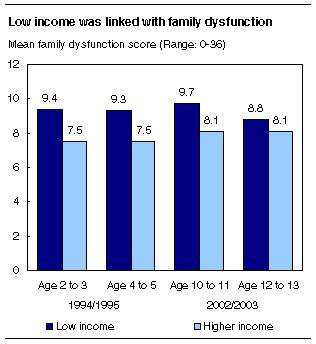
To measure family dysfunction, parents were asked about problems with family functioning, including communication, roles, affective involvement and responsiveness, behaviour control, and problem-solving within the family. Dysfunctional families were those where frequent problems were reported.
NLSCY data show that both family dysfunction and maternal depression were linked with income, but punitive parenting practices were not.
At the age of 2 to 5, low-income children experienced higher levels of family dysfunction than children in households with higher incomes. Eight years later, the link between low income and family dysfunction persisted for children aged 10 to 11, but was no longer significant for those 12 to 13.
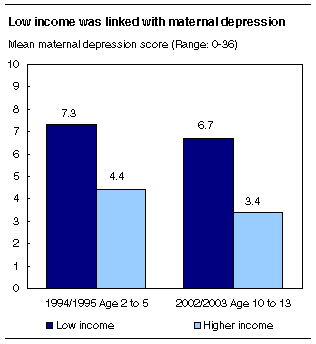
Similarly, the survey showed an association between depressive symptoms reported by the parent, usually the mother, and income levels.
Parents of children in low-income households scored higher on a measure of depression than did parents of children in higher income households. The link between low income and maternal depression was found at both stages: when the children were aged 2 to 5 and eight years later when they were 10 to 13.
In contrast, the survey found no differences between children in the two income groups in the level of punitive parenting practices reported, at either stage. In other words, children living in low-income households were not subjected to higher levels of punitive parenting practices than children who did not live in low-income homes.
Financial circumstances improved for most low-income children over time
Financial circumstances improved for most children living in low-income households during the eight-year period.
Financial circumstances in 1994/95 and 2002/03 |
|||
|---|---|---|---|
Income category in 2002/03 |
|||
| 1994/95 | Low income | Higher income | |
| % | |||
| Children living in a low-income family in 1994/95 | 26 | 43 | 57 |
| Children living in a higher-income family in 1994/95 | 74 | 9 | 91 |
In 1994/95, just over one-quarter (26%) of children aged 2 to 5 were in households below Statistics Canada's low-income cut-off. However, by 2002/03, when they were 10 to 13, more than one-half (57%) of these children were no longer in low income.
That means that 43% of the children who were in low income in 1994/95 were still there in 2002/03. In contrast, only 9% of the children outside low income in 1994/95 had slipped below the cut-off eight years later.
Other home environment factors associated with behaviour
Dysfunction in the family was associated with anxiety in young children aged 2 to 5. Also at these ages, depression experienced by the parent was associated with higher levels of aggressive behaviour and anxiety in the children.
Eight years later, when the children were 10 to 13, the picture was somewhat different. Children living in families where dysfunction scores were high did not differ from other children in aggressive behaviour, anxiety or pro-social behaviour.
Similarly, children aged 10 to 13 in homes where the parent had high depression scores did not differ from other children in any of these behaviours.
Definitions, data sources and methods: survey number 4450.